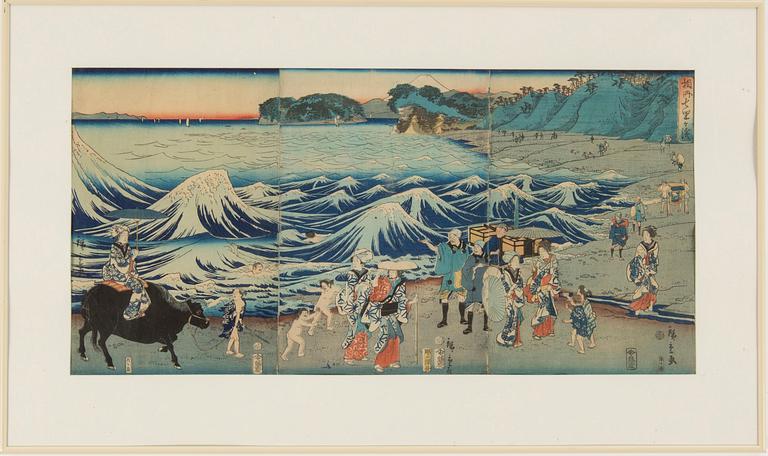
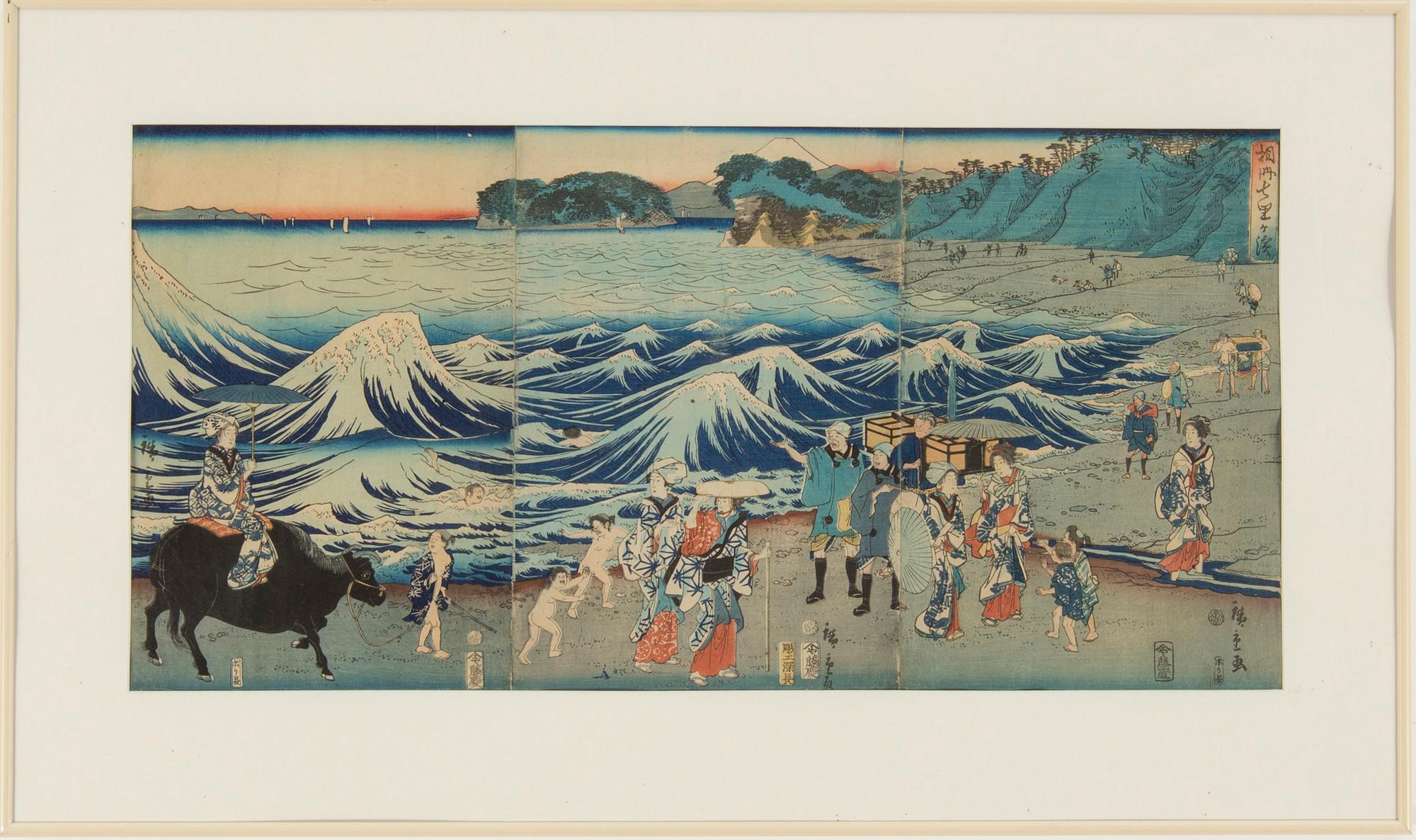
ANDO UTAGAWA HIROSHIGE, woodblock print, triptych, second half of the 19th century
"Seven mile beach, province of Sagami". In the distance in the left and middle panels is the island of Endoshima, with snow-capped Mt Fuji on the horizon in the middle panel. The shrine to Benten, goddess of wealth and good fortune, is located on the island, which is still a popular pilgrimage destination. Naked children are playing and swimming in the waves. On the beach are groups of tourists and pilgrims. Their gaze is directed towards a woman holding a parasol and riding on an ox, led by a young boy. She possibly represents the goddess Benten, appearing as though in a vision. (This scene could also be a parody of two popular kabuki plays of the time, in which the main character rides an ox.) (NGV Art Journal, 34, Mae Anna Pang, "Japanese woodblock prints: a mass medium"). 35 x 72cm.
Not examined out of the frame. Fold marks. Faded. The three sheets assembled toghether. Paper uneven.
Provenance
The Collection of Emil Hultmark.
More information
Compare with National Gallery of Victoria, Melbourne; Acession Number 529.a-c-2.
More about Ando Utagawa Hiroshige
Ando Hiroshige is one of the most renowned a Japanese painters born in Edo. He began his artistic career as an apprentice to Utagawa Toyohiro. After completing his training, Hiroshige took his teacher's name and started signing his works Utagawa Hiroshige. Hiroshige painted motifs from everyday life, and it is said that he decided to become an artist after seeing the works of the contemporary artist Hokusai. Hiroshige transformed ordinary landscapes into intimate, lyrical scenes. He is particularly known for his beautiful landscape images in the woodblock printing technique and has painted portraits of young women and actors. His masterpiece is considered to be the work “Fifty-three Stations of the Tokaido.”
Read more